The persona
This entry compares named persona accounts only as examples inside a third-party study; it does not establish new facts about any one persona beyond what that study reports. The personas named, including Lil Miquela and Rozy, are studio-operated accounts whose engagement figures below are the study's own measurements of those accounts' public posts.
What the documents establish
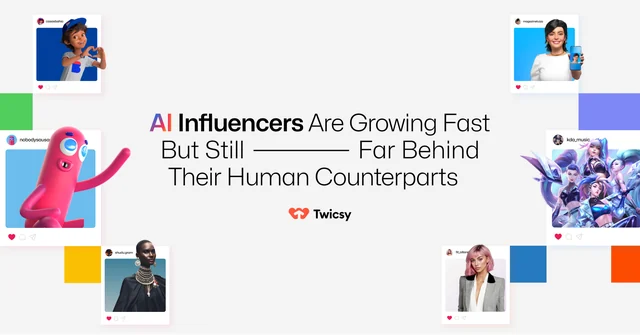
As retrieved on 16 September 2026, social-media marketing vendor Twicsy's own study, 'AI vs Human Instagram Influencers: Who Will Win?', states it examined 'a total of 11,514 virtual influencers and their human counterparts' and found human-run sponsored posts receive 187,039 likes and 2,049 comments on average against 86,786 likes and 1,953 comments for AI-run accounts, a gap Twicsy describes as 266 percent higher engagement for human influencers, alongside a stated 46-times gap in average per-post earnings. HypeAuditor's own blog, in a page titled 'AI Influencers vs Human Influencers: Who's Best for Brands?', republishes this Twicsy analysis of HypeAuditor's underlying data and adds specific account comparisons, citing Lil Miquela's engagement rate as 'less than 0.01 percent' against a 6.04 percent rate for a named human creator, and separately comparing Rozy's Audience Quality Score of 70 to a named human creator's score of 58 on the same scale.
Character versus company
The engagement gap Twicsy and HypeAuditor describe is a measured outcome of each operator's posting and audience-building choices, not a property of the persona's fictional identity; a low engagement rate reflects how Lil Miquela's operator has run that account relative to a comparison creator's account, not any quality inherent to a CGI character as such. HypeAuditor's own page frames the comparison as a business question for brands weighing 'AI or human influencers,' language that treats the persona as a marketing product the operator offers, consistent with how this site separates operator decisions from a character's storyline.
What to watch
Twicsy's page carries no visible publication date, so this entry cannot confirm when its 11,514-account sample was drawn or refreshed; HypeAuditor's version of the analysis was created 27 March 2025 and shows a 16 September 2026 update stamp. Engagement definitions (likes and comments) may not translate directly to platforms that weight views or watch time differently, a limitation neither document addresses directly.
- Does the cited engagement figure use likes-and-comments, view counts, or another metric, and does that match the platform in question?
- When was the underlying sample of accounts drawn, and could it be dated relative to when the figure is being cited?
- Is the named human comparison account similar in follower count and posting frequency to the persona it is measured against?
Together, the two documents show a consistent, if unevenly dated, finding that named human comparison accounts outperformed the named virtual personas on likes and comments in this specific sample, a result this entry treats as bounded by Twicsy's stated sample and HypeAuditor's own scoring method rather than a universal rule.
Source ledger.
- AI vs Human Instagram Influencers: Who Will Win? ↗
Twicsy's own study of 11,514 accounts stating the likes, comments and earnings gap between human and AI-run influencer accounts.
Source publication: Not stated · Retrieved: 2026-09-16
- AI Influencers vs Human Influencers: Who's Best for Brands? ↗
HypeAuditor's republication of the Twicsy analysis with named-account comparisons for Lil Miquela and Rozy.
Source publication: 2025-03-27 · Retrieved: 2026-09-16