The persona
This entry, like the trust-focused study it complements, concerns audiences in general rather than one named persona; the underlying experiment used a virtual influencer as a test stimulus rather than reporting on any specific site-tracked character's actual account.
What the documents establish
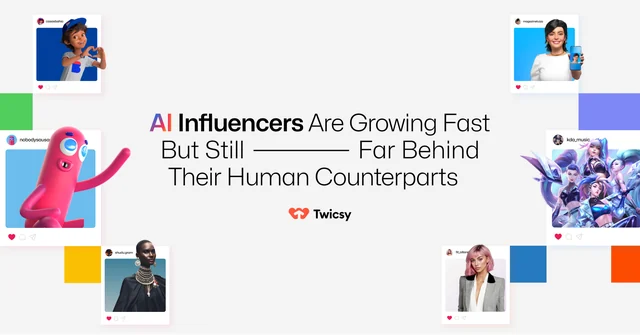
Jan-Philipp Stein, Priska Breves and Nora Anders's paper, 'Parasocial interactions with real and virtual influencers: The role of perceived similarity and human-likeness', posted online in June 2022 in New Media & Society, describes a preregistered experiment with 179 participants comparing parasocial responses to a human influencer against a virtual one using natural, matched stimuli. Its own abstract states overall parasocial interaction did not differ significantly between the two groups, but that participants attributed the virtual influencer with 'less mental human-likeness and similarity to themselves,' an effect that suppressed a separate direct advantage the study found favoring stronger parasocial interaction with the virtual persona. Thomas and Fowler's earlier paper, 'Close Encounters of the AI Kind', offers a related but distinct finding: that consumers are less likely to treat an AI influencer as a unique individual compared with a human celebrity endorser.
Character versus company
Neither study measures whether a viewer can correctly identify a persona as CGI-generated in a forced-choice sense; both instead measure perceived human-likeness and similarity on rating scales, a related but narrower question than binary detection accuracy. That distinction matters for any operator's claim that its persona is 'indistinguishable' from a real person: these two papers suggest audiences do register a virtual persona as less human-like even when their emotional engagement with it is comparable to a human influencer, which is a finding about perception, not proof that operators disclose or fail to disclose a persona's synthetic nature.
What to watch
This entry relied on publisher-registered abstracts rather than the full paywalled text of either study, so the exact statistical strength of the human-likeness effect described above should be checked against the original article before being cited as a precise figure. Neither study reports a percentage of participants who correctly identified the virtual stimulus as synthetic, so no detection-accuracy rate can be attributed to either paper.
- Did the study measure perceived human-likeness on a scale, or a binary correct/incorrect identification, and which is being cited?
- Does the study's stimulus format (image, video, text) match the platform or format a reader is generalising to?
- Has a study using a forced-choice detection test, rather than a rating scale, reached a comparable conclusion?
Read together, these two papers indicate that audiences perceive a gap in human-likeness between virtual and human personas without that gap necessarily reducing engagement, a more precise and more limited claim than a general assertion that people 'can't tell the difference' between a CGI persona and a real one.
Source ledger.
- Parasocial interactions with real and virtual influencers: The role of perceived similarity and human-likeness ↗
Publisher-registered abstract describing the preregistered experiment's method and its human-likeness/similarity finding.
Source publication: 2022-06-13 · Retrieved: 2026-09-16
- Close Encounters of the AI Kind: Use of AI Influencers As Brand Endorsers ↗
A related, earlier finding that consumers are less likely to treat an AI influencer as a unique individual than a human celebrity.
Source publication: 2020-09-11 · Retrieved: 2026-09-16